Saturday at Charles Darwin University began with the business of the industry, before turning to the business of making pictures.
Screen Territory Senior Director Jennie Hughes opened with an update on the Northern Territory screen industry and its future direction. Staci Mellman, Chief Marketing Officer of Tourism and Events NT, followed with a discussion of the growing relationship between tourism and screen production and the opportunities that emerge when the 2 sectors work together. ACS President Brent Crockett then delivered the Australian Cinematographers Society keynote, examining the state of cinematography in Australia and the evolving role of the cinematographer in contemporary production.
Taken together, the opening sessions established the topics that would run through the weekend: how an industry sustains itself, finds its audience and develops the people and skills needed to make work of lasting value.
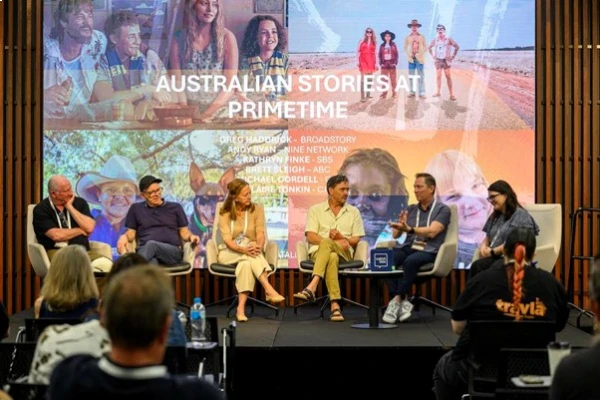
The first panel, moderated by Natalie Apostolou, was Australian Stories at Primetime. The session brought showrunner Greg Haddrick and CJZ's Michael Cordell and Claire Tonkin together with Andy Ryan of Nine and Stan, Kathryn Fink of SBS and Brett Sleigh of the ABC. This dynamic and candid conversation moved beyond the familiar question of what broadcasters want to hear. It examined what is actually being commissioned, how the definition of primetime is changing and what happens when audiences no longer gather around the same screen at the same hour.
The commissioning perspectives were distinct, and usefully so. Questions from the floor were direct, reflecting the experience of practitioners who spend their working lives developing, producing and pitching Australian stories. The discussion made clear that understanding the market means understanding not only what gets a yes, but why a project might not.
However, the morning's centrepiece was Crocodile Dundee at 40: The Film That Changed Australian Cinema and Tourism.
Forty years after the film introduced Kakadu to audiences around the world, Australian screen icon Delvene Delaney and Victoria Baldock revisited the production that became one of Australia's defining cinematic exports.
Delaney worked on the original film alongside her late husband, John Cornell, and produced its sequel, Crocodile Dundee II. Delaney and Baldock later co-directed Love of an Icon: The Legend of Crocodile Dundee, which also served as the basis of a considerably more revealing discussion than just a celebration of a familiar classic.
Delaney graciously offered an unusually candid account of the 1985 production, sharing details of the shoot, the practical realities of working in the Top End and the evolution of John Cornell and Paul Hogan's extraordinary relationship from The Paul Hogan Show into the creation of Australia's most iconic film. Baldock also contributed her insights following directing Love of an Icon, moving between the mythology surrounding Crocodile Dundee and the ongoing impacts it has had on Australia's screen industry landscape.
After the morning's discussion, the program turned to the craft of storytelling itself. Spin Me a Yarn: Storytelling with Screenwriters (moderated by Craig Proudley) brought together some of Australia's very best screenwriters in John Collee, Sam Meikle, Greg Haddrick, Sarah Smith and Tim Bain, to examine the instincts, techniques and experience behind compelling screen stories. The panel was a fascinating exploration of methodologies, genre, structure and somewhat surprisingly, the great bard, Shakespeare.
The afternoon moved from the written story to the image with The Art of Aesthetic: High End Commercials That Captivate. Dylan River, Anna Howard ACS, Gemma Lee, Stefan José and Casimir Dickson ACS examined the visual demands of commercial filmmaking, where cinematography, lighting, composition and production design must work together to communicate an idea in seconds.
Commercial work is sometimes treated as the space between larger dramatic productions. In reality, it demands its own discipline. The frame must be precise, the visual language immediately legible and the creative choices aligned with a tightly defined brief.
For Territory practitioners, that relationship has particular significance. A landscape can be an extraordinary production asset, but its presence alone does not make an image compelling. The question is not simply how to photograph the Territory, but how to make the image serve the story, the product or the brief.
The day's final masterclass, Colour Grading in Practice, brought Lauren van Rensburg and Jade Robinson of KOJO to the full production pipeline, from on-set capture and data management to the creative decisions that shape mood, narrative emphasis and audience perception.
Colour grading is often associated with the final polish of a film. Its influence begins much earlier. The intended look must survive the journey from the camera through post-production, requiring a shared understanding of visual intent across departments. The relationship between technical workflow and creative judgement is central to that process: a grade can unify a film's visual language, but only if the decisions made along the way preserve the material needed to achieve it.
To see photos of the NT Screen Summit, go to the Screen Territory Facebook page.