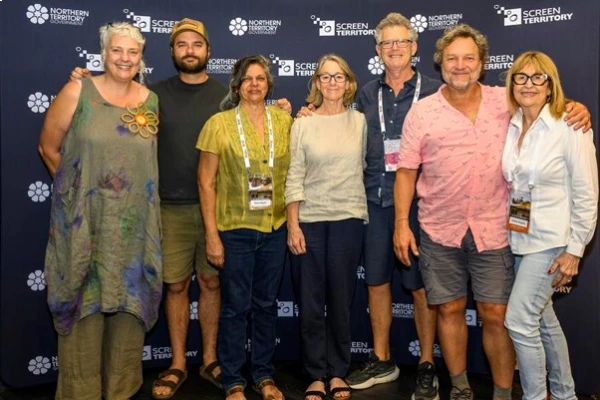
Sunday began with Production Design: Building Worlds for the Screen, giving Helen O'Loan, Matthew Putland and Michael Leon the opportunity to examine a discipline fundamental to the way audiences experience a film. Their credits, spanning Deadloch, Black Snow, Territory, The Artful Dodger and Nine Perfect Strangers, reflected the range of demands placed on production design. Moderated by Panavision's Nic Godoy, the discussion considered how screen worlds are conceived, constructed and brought to life, and how space, texture and visual detail can shape character, tone and narrative.
Production design is often most successful when the audience does not notice it. Yet it is fundamental to the credibility of a screen world and to a director's ability to place characters within it. A set must function in physical space while also working within the frame, the light and the wider visual language of a production. What reads convincingly on the day may look very different through a lens.
The session gave a department that can be overlooked in broader conversations about filmmaking dedicated attention to its creative and practical responsibilities.
The next panel, The Relationship Between Directors and Cinematographers, brought Dylan River, Erica Glynn and Jeremy Sims together with Anna Howard ACS and John Stokes ACS to consider the creative partnership between the person shaping a scene and the person determining how it will be seen.
Collaboration is an easy word to use when discussing filmmaking. The reality is more complicated. A director's intention must meet the physical possibilities of a location, the demands of the light and the limitations of time. The cinematographer brings a distinct creative perspective, not simply a technical means of executing somebody else's vision.
Following the lunch break, the program split into 2 concurrent sessions. In the main lecture theatre, cinematographer Andy Taylor ACS presented an incredibly generous and interactive panel entitled Beyond Coverage: Designing Cinematography for Factual. The fascinating masterclass explored Andy's phenomenal career, having worked across more than 150 countries, capturing images in some of the most impermissible environments possible, including conflict zones and Antarctica.
At the same time, in the foyer study stairs, Joey Egger, Head of Games at Screen Australia, led Press Start: A Conversation with Joey Egger. The session turned attention to the Australian games sector, examining emerging talent, funding and the opportunities for creators to take stories, worlds and characters to new audiences through different forms of screen content. The inclusion of games reflected a broader question for the industry: how intellectual property can travel across formats, and how the boundaries between screen storytelling and interactive experiences are changing.
The afternoon continued with the Wildstate Case Study: Through the Dust, in which LA-based producer John Graham and cinematographer Stefan José examined the making of a 30-minute YouTube film following Robbie Maddison's first Finke Desert Race. Moderated by Screen Australia's Head of Factual, Richard Huddleston, the case study brought together talent, story, Central Australian landscapes and the challenge of shaping a finished film for a digital audience.
It was a useful counterpart to the weekend's discussions of traditional commissioning and production. The platform may differ, but the central questions remain: where is the story, what makes it worth following and how should the material be shaped for the audience it is intended to reach?
At 3pm, attention returned to the wider industry with Greg Haddrick moderating Screen Australia: What Comes Next? where senior Screen Australia leadership - Richard Huddleston, Tanya Phegan, Rachel Perkins, Adrian Coates and Joey Egger - brought perspectives spanning strategy, narrative, factual, First Nations and games content to a discussion of the changing screen landscape.
The session brought the weekend's industry and craft conversations back together. Creative ambition matters, but so does an understanding of the structures through which work is financed, produced and ultimately seen.
The final masterclass, The Sky Is the Limit: Expanding the Language of the Aerial Image, placed Alice Springs-based cinematographer Chris Tangey alongside Andy Taylor ACS and Felix Baker to examine the possibilities of aerial cinematography.
With more than 35 international aerial cinematography awards to his name, Tangey has built a reputation in a field that can easily become dominated by spectacle, while both Andy and Felix are used to having to achieve impactful shots under time-sensitive situations. The session explored the creative and practical considerations behind aerial work, from planning and regulation to the decisions made on set.
The Territory offers extraordinary opportunities for this kind of cinematography, particularly in the Centre, where the scale of the landscape can tempt filmmakers to rely on spectacle alone. The more interesting question is what an aerial image contributes to the story. Geography, movement, perspective and emotional tone can all be shaped from the air, and discussions proved that an aerial shot does more than establish that a place is vast or remote.
It was a fitting final session for a weekend concerned with the choices that sit behind the finished image and let attendees take off to the end of the summit networking event, presented by the Australian Film Television and Radio School (AFTRS) and Screen Territory at Flicks.
It was a phenomenal weekend, and ultimately the ongoing value of the NT Screen and Cinematic Craft Summit lies in what happens after the room empties; the relationships formed, the ideas tested and the knowledge shared across 2 days are only the beginning.
For the Northern Territory, the opportunity is to turn that exchange into stronger productions, deeper craft capability and a screen industry increasingly confident in what it can make and where its stories can travel.
The NT Screen Summit is also an opportunity to integrate our industry representatives into other areas of the Northern Territory Government and to assist in fostering relationships more broadly. As such, we were delighted to be able to work with our colleagues in Tourism and Events NT to facilitate visitation for some of the delegates to the MXGP event that was occurring the same weekend.
To see photos of the NT Screen Summit, go to the Screen Territory Facebook page.